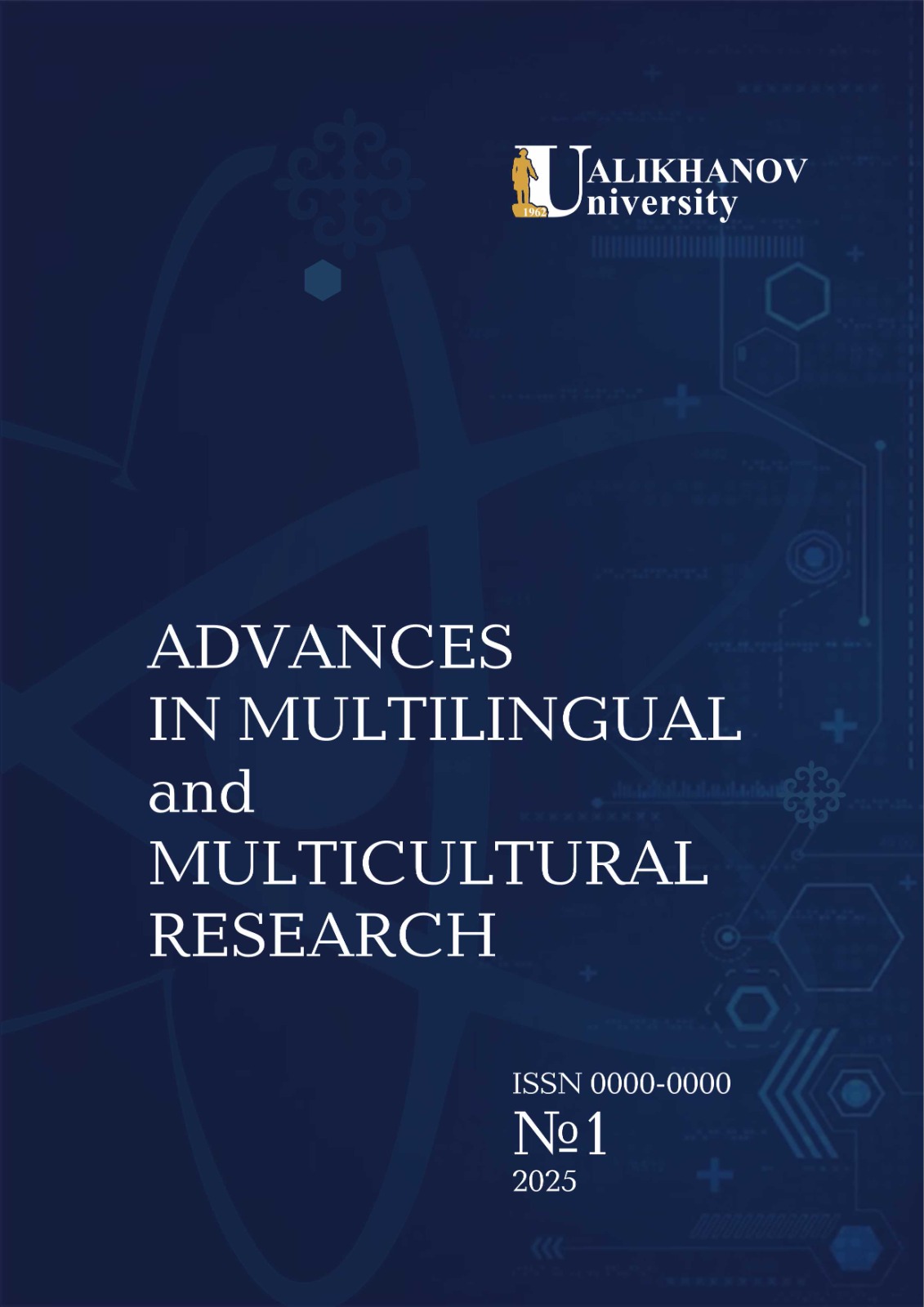
Functional Multilingualism in the Northern Kazakhstan: A Comparative Study (2017–2022)
Authors
-
Zhailagul Sagyndykova
Shoqan Ualikhanov University, Kokshetau, Kazakhstan
 https://orcid.org/0000-0003-1427-7417
-
Anna Svinarchuk
Abay Myrzakhmetov University, Kokshetau, Kazakhstan
https://orcid.org/0009-0002-4868-6059
-
Aizhan Sharipova
Shoqan Ualikhanov University, Kokshetau, Kazakhstan
https://orcid.org/0000-0003-1291-2253
-
Brian Baer
Kent State University, Ohio, USA
https://orcid.org/0000-0002-5238-0258
-
Bella Gazdiyeva
Shoqan Ualikhanov University, Kokshetau, Kazakhstan
https://orcid.org/0000-0003-1727-7631
 https://doi.org/10.59102/ammr/2026/iss1/art02
Keywords:
multilingualism, trilingualism, self-reported language assessment, comparative analysis, language useAbstract
This study examines language use, language preferences and self-reported multilingual practices among young residents of the Aqmola region between 2017 and 2022. The questionnaire was conducted among 60 residents of the Aqmola region aged from 15 to 25 years to see how they use Kazakh, Russian and English languages. The data were collected through a questionnaire survey, analyzed using SPSS and interpreted through quantitative comparative analysis. The findings suggest multilingual tendencies among the respondents, where Kazakh, Russian and English are used in different communicative and educational contexts, while some participants additionally reported the use of the other heritage or ethnic languages. Moreover, the study indicates that multilingualism in Kazakhstan has not been researched in relation to specific regions, especially in linguistically diverse areas like the Aqmola region.References
1. Agency of Strategic planning and reforms of the Republic of Kazakhstan. (2022). Bureau of National Statistics. Derived from: Population Census 2021. https://stat.gov.kz/ru/instuments/dashboards/28478/
2. Anastassiou, Fotini, Georgia Andreou, and Maria Liakou. (2017). Third language learning, trilingualism and multilingualism: A review. European Journal of English Language, Linguistics and Literature 4.(1): 61-73. idpublications.org
3. Aubakirova, B., Mandel,K. & Benkei-Kovacs, B.(2019). European experience of multilingualism and the development of multilingual education in Kazakhstan. Hungarian Educational Research Journal 9(4): 689–707. https://akademiai.com/loi/063. DOI:10.1556/063.9.2019.4.56 DOI: https://doi.org/10.1556/063.9.2019.4.56
4. Auer, P., & Wei, L. (2007). Handbook of Multilingualism and Multilingual Communication. Berlin, New York: De Gruyter Mouton. DOI: https://doi.org/10.1515/9783110198553
5. Cenoz, Jasone. (2005). English in bilingual programs in the Basque country. International Journal of the Sociology of Language. 171: 41–56. https://www.degruyterbrill.com/document/doi/10.1515/ijsl.2005.2005.171.41/html DOI: https://doi.org/10.1515/ijsl.2005.2005.171.41
6. Constitution of the Republic of Kazakhstan. (1995).https://www.akorda.kz/en/constitution-of-the-republic-of-kazakhstan-50912
7. Grosjean, François. (2010). Bilingual: Life and reality. Harvard University Press. https://books.google.com DOI: https://doi.org/10.4159/9780674056459
8. Hoffmann, Charlotte. (1985). Language acquisition in two trilingual children. Journal of Multilingual and Multicultural Development. 6(6):479-495. doi:10.1080/01434632.1985.9994222 DOI: https://doi.org/10.1080/01434632.1985.9994222
9. Hoffmann, Charlotte. (2001). Towards a description of trilingual competence. International Journal of Bilingualism 5(1): 1-17. https://doi.org/10.1177/13670069010050010101 DOI: https://doi.org/10.1177/13670069010050010101
10. Jessner, Ulrike.(2006). Linguistic awareness in multilinguals: English as a third language. Edinburgh University Press. https://books.google.com DOI: https://doi.org/10.1515/9780748626540
11. Koptleuova, Kulpash (Balgenzhе Karagulova, Bagila Muratbek, Mairagul Kushtayeva, and Kulshat Kondybay). (2022). “Sociolinguistic and Extralinguistic Aspects of the Functioning of Trilingualism in the Oil Industry of Kazakhstan”. PSYCHOLINGUISTICS 31 (2), 57-77. https://psycholing-journal.com/index.php/journal/article/view/1233. DOI: https://doi.org/10.31470/2309-1797-2022-31-2-57-77
12. Koptleuova Kulpash (Balgenzhe Karagulova, Anargul Zhumakhanova, Kulshat Kondybay and Aiymgul Salikhova).Multilingualism and the Current Language Situation in the Republic of Kazakhstan. International Journal of Society, Culture & Language 11 3 (2023): 242-257. doi: 10.22034/ijscl.2023.2007080.3099
13. Koptleuova, Kulpash (Akhmaral Khairzhanova, Abdizhalil Akkuzov, Ulbolsyn Kaiyrbekova, Ainur Akkuzova. (2023). The Language Situation in the Healthcare Sector of the Republic of Kazakhstan. Eurasian Journal of Applied Linguistics, 9(2), 118-131. https://ejal.info
14. Nazarbayev, N. (2007). President's Address to the Nation: New Kazakhstan in a New World. https://www.akorda.kz/ru
15. Sagyndykova, Z., Svinarchuk A., & KubrinaT., (2017) Polylingvalnaya kommunikaciya v Kazakhstane: Rechevoe I Tekstvoepredstavlenie [Polylingual communication in Kazakhstan: Speech and text production]. Kokshetau, Kazakhstan: Мirpechati.
16. Smagulova, Z. (2008). Language Policies of Kazakhization and Their Influence on Language Attitudes and Use. International Journal of Bilingual Education and Bilingualism 11(3-4): 440-475, doi: 10.1080/13670050802148798 DOI: https://doi.org/10.1080/13670050802148798
17. Tagliamonte, S. (2006). Analysing sociolinguistic variation. Cambridge University Press. https://books.google.com DOI: https://doi.org/10.1017/CBO9780511801624
18. The Law on languages in the Republic of Kazakhstan.151-I Kazakhstan. Part 1, 2. (1997). https://online.zakon.kz/
19. Tokayev, K. (2019). President's Address to the Nation: Constructive Public Dialogue - The Basis of Stability and Prosperity of Kazakhstan. https://www.akorda.kz/ru
20. Tokayev, K. (2020). President's Address to the Nation: Kazakhstan in a New Reality: Time for Action. Accessible and Quality Education. https://www.akorda.kz/ru
21. Tokayev, K. (2021). President’s Address to the Nation: Unity of the People and Systemic Reforms are a Solid Foundation for the Nation’s Prosperity. https://www.akorda.kz/ru
22. Tokayev, K. (2022). President’s Address to the Nation: A Fair State. One Nation. Prosperous Society Strategic Investment in the Country’s Future. https://www.akorda.kz/ru
23. Trilingual education in Kazakhstan. (2017) https://online.zakon.kz/Document/?doc_id=37744692&pos=4;-98#pos=4;-98
24. Wei, L. (2020). “Dimensions of bilingualism.” In The Bilingualism reader edited by L.Wei. London: Routledge. https://vulms.vu.edu.pk/Courses/ENG512/Downloads/%5BLi_Wei%5D_The_Bilingualism_Reader(BookFi).pdf DOI: https://doi.org/10.4324/9781003060406
Downloads
Published
How to Cite
Issue
Section
License
Copyright (c) 2026 Zhailagul Sagyndykova, Anna Svinarchuk, Aizhan Sharipova, Brian Baer, Bella Gazdiyeva

This work is licensed under a Creative Commons Attribution 4.0 International License.